Whoops, As I reviewed the inspiring entries in our Pitch Your Book to Life Contest, I realized that a few did not make it onto the blog. So, here is my feedback on several more inspiring and terrific entries.

Whoops, As I reviewed the inspiring entries in our Pitch Your Book to Life Contest, I realized that a few did not make it onto the blog. So, here is my feedback on several more inspiring and terrific entries.

Amy O’Brien, author of Stuck with Mr. Wrong: 10 Steps to Starring in Your Own Life Story has won four awards for this powerful, creative and fun book. I asked Amy to share some of her secrets to winning awards:
Lisa: What process did you go through to identify the awards?

Lisa: How many contests did you enter?
Amy: Four: International Book Awards, National Indie Excellence Awards, USA Best Books, and Next Generation Indie Book Awards. I won two International book awards (Winner: Best Self-Help Relationships, Finalist Best New Non-Fiction), one National Indie Excellence (Finalist: Best Self-Help) and one USA Best Book (Finalist Best Self-Help: Relationship).
Amy: I was invited to speak at the What Women Want (now called Inner Woman) series and I have another lead to follow up on today. Being a “Four-Time Award-Winning Author” has a nice ring to it. Especially as a self-published author, it adds credibility to my work. I plan to use this to book additional speaking gigs.
Amy: All you have to do is complete the entry form and identify what categories you are entering. I didn’t have to answer any questions.
Lisa: I know how fulfilling it’s been for you to hear back from readers whose lives have been transformed by your powerful book. I imagine that these contests and the speaking will help you have an impact on even more people. Congratulations.
Here are some links to writing contests:
Next Generation Indie Book Awards
Feel free to share questions for Amy, share any awards your books have won, advice or contests you recommend.

Ever wondered what a radio show host is thinking, how they choose the guests they choose, what they look for in a guest and how to get asked back? In today’s post, I interview Robin Kall, host of Reading with Robin on WHJJ Providence.
I first met Robin at the Anniversary Party for Reading with Robin. I was struck by her warmth and wit and immediate invitation to be a guest on her show, despite the fact that she covered more fiction than how-to books. I’ve been on the show several times since then, including a special book club show where we discussed Sue Monk Kidd’s The Secret Life of Bees and I got to ask Sue my burning questions about her book.
Lisa: How did you get started doing your show?
Robin: I started on-air career as a caller to The John Depetro Show. When I first started calling in I was nervous but as the calls became more and more frequent lasting for longer amounts of time I became comfortable with being on-air and was eventually invited into the radio station. I was hooked. Several months later I was asked to do a couple of fill-in hours for John’s show and once I felt comfortable with the radio persona I pitched an idea to the program director about hosting my own show. As an avid reader who loves to talk, the idea for Reading with Robin was a natural!
Lisa: How many books do you get in a typical week?
Robin: About 15-20 unsolicited books and 5 or so that I request.
Lisa: How do you even choose which ones to consider? What questions are you asking as you select what to read?
Robin: For the most part I’m considering the ones I’ve requested. After so many years of doing the show the publishers I work with have a sense of what I’m looking for and have me on those types of book lists. I open up every one of those book envelopes that arrive.
If it’s one I haven’t requested I look it over and see if there’s something about it that piques my interest. It might have blurbs (author quotes) by authors I’m familiar with and those I’ll take a closer look at. If it’s a non-fiction topic I haven’t covered and that’s relevant I’ll take a closer look.
For the most part my show is aimed at a female audience and I’m a huge fiction reader. That’s not to say I don’t consider YA titles and children’s books. I do those from time to time. I also prefer to work with major publishers for the most part, but there are exceptions. I’m only on for one hour per week. I could easily fill 20 hours weekly with great books except that my show is not 20 hours and I’d never be able to read that many books as I have a full life away from the radio show.
After hosting for almost 9 years I have a strong sense of what my audience is hoping for when they tune in on a Saturday morning. I often ask myself if this is something I’d want to listen to. If I’m not excited about a guest, it would come through loud and clear!
Lisa: And your passion really shows. I am one of the lucky nonfiction authors you’ve interviewed! When deciding who to interview, is it all about the book or also about the author and how well they interview?
Robin: With some first time guests, I have no idea how they’ll interview. Sometimes the book is an indication of the type of guest they’ll be but not always. There have been a few surprises over the years. It always works out fine as there is always something interesting to pull from a conversation.
If I notice someone’s writing personality isn’t jumping out into the airwaves, all I need to do is mention animals and for the most part the conversation takes an immediate spike in enthusiasm or more of a comfort level. I remind authors before the show that the show is conversational, laid back and just to think of it as chatting with a friend on the phone.
Lisa: And you really put authors at ease. It comes across. How often do you have guests back? Who have you had back more than once and why?
Robin: The guests I’ve had back are the writers I enjoy who often are putting out books if every year or every other year—Jodi Picoult, Jennifer Weiner, Claire Cook, Alice Hoffman, Allison Pace, Elizabeth Berg, Courtney Sullivan and the list goes on.
I happen to love having on a debut novelist and there is plenty of room on my show for those. Often authors will email about a new author they have come across and sometimes these authors will share an agent or publisher.
If it’s a writer I respect I will always take a look. Most authors understand the time limitations but I never want to miss out on a great title. In order to fit in more interviews I will sometimes tape a segment during the week and air those on my website.
Lisa: What’s your advice to new authors who want to get interviews? How can they increase their odds of being chosen as a guest? (if they can)
Robin: Do not be a nudge.
Lisa: What advice can you give writers to make their interview juicy and compelling? As a host, what makes the best guests?
Robin: I like to talk off-topic of the book. Something might strike me during conversation and we might go in another direction. I always get back to the book/topic but I think it’s fun to chat about things that might be unexpected. This is not an NPR-type interview. I add in humor whenever possible and mostly it’s well-placed.
Lisa: Yes, I think that’s part of what makes your interviews so popular–the conversational style and the suprises that come up. Anything else you want to add?
Robin: I have a big author event coming up on Wednesday, Sept. 21st. This is my annual fundraiser to kick off the ACS Making Strides Against Breast Cancer Walk. Details are still being worked out but so far Courtney Sullivan is confirmed to come. Authors in the past have included Jennifer Weiner, Claire Cook, Tom Perrotta, Ann Hood, Jane Green. It’s always a fabulous event and grows each year. If you’d like an evite please send me an email at robin@readingwithrobin.com
Lisa: Local readers of this blog can attend Robin’s event and rush home for the Birth Your Book: Inspiration to Published Author call at 8:30pm! Robin, thanks for all this great information. I’d like to open this up for readers now and invite you to ask your questions and Robin will answer! Feel free to share comments as well.

In preparing for my presentation on Building Your Online Platform at URI’s Ocean State Summer Writing Conference, I’ve been looking for good examples of authors who use their Facebook page effectively or who have created great YouTube book trailers and other author videos.
Well, that could take a great deal of research time, but not if you help me. So, please nominate your favorite examples and the winners will receive:
A copy of my special report: Writing Breakthrough: 5 Powerful Steps for Inspiration and Flow to help you eliminate blocks and consistently write from an inspired place
More prizes to be announced shortly…Can you nominate yourself? Of course!
Nominate them here as a comment. Share the link and anything else you’d like to say. And I hope to see you at URI June 23-25 for an inspiring and brilliant writing conference.

My fabulous Virtual Assistant Geri Lafferty told me to snag my Amazon Central Author Page a few weeks ago. Last night, my husband, Tom,an expert on SEO (search engine optimization) and Google searches echoed her suggestion. Tom often tells me what to do–and his advice works–I usually come up first and second place for searches on “writing coach,” “book writing coach” and “book proposal coach” on Google. I finally hopped to it, staying up past midnight to complete it.
No. That’s not because it was complicated at all. It’s because I started on the project around 11:30 pm and couldn’t figure out my RSS feed blog address (I finally got smart, e-mailed my web guy at BoomTown Internet and heard back first thing this morning) !
It will take you anywhere from 15 – 45 minutes, depending on whether you already have a bio you like. You can import your twitter feeds, blog posts, upcoming events and even videos (that’s the part I still need to complete).
Yes, any links are “No Follow” which means you may not get credit with Google for them but here are 3 reasons to do it anyway:
1. Amazon Author Central provides sales data for your book(s) from Bookscan. Okay, this is huge. When distributors stopped making sales data available to authors a few years back it meant that the only data you got was from your publisher. Have you ever tried to read a publisher’s report? Confusing, and not terribly detailed. In contrast, Amazon Author Central provides sales data over a period of time, by geography and Amazon ranking. While Bookscan data does not reflect all sales, it includes about 75% or more. This is awesome.
2. The Internet rewards those who reach out to their tribe (readers) wherever their tribe hangs out. If your tribe hangs out at Amazon, you want a presence and you want to be approachable and interactive. And does your audience hang out at Amazon? I should hope so, if you want them to buy your book.
3. You can offer several ways for new readers and existing fans to interact with you, meeting their specific needs and interests: blog, twitter feeds, videos, etc. You can even start a discussion with your readers.
Sold? Check out my Author Central Page to see how I did it. (and please give me a like while you’re there). Then, start your Amazon Author Central Page today and set it up with your bio, book(s), photo, twitter and blog feeds, etc. and tell me what you like most about it. Share your link here as well, so we can look you up and like you!

The biggest challenge for most new authors who aspire to be picked up by a traditional publisher is to develop a large enough following. Several of my clients have recently signed contracts with literary agents or publishers had to develop their “author platform” first.
Recently, I spoke to Dan Janal, founder of PR Leads Plus which helps authors, speakers, coaches and small businesses get publicity with do-it-yourself tools and done-for-you-services. Dan told me he’s using press releases in all kinds of creative ways–and not just for traditional publicity. It helps your website’s ranking with search engines, for instance.

I’ll be interviewing Dan on December 9 at 1:00 pm eastern time on How to Get Publicity on Major Media Websites to get more qualified prospects to visit your site. This will help you whether you’re building your following before writing the book and getting a publishing deal or if you already have books to sell.
I’ve asked Dan to share a little more about the power of press releases with us on this blog.
Lisa: How have press releases changed with the Internet?
Dan: In the old days, you sent press releases to reporters and, if they acted, great. If they didn’t, you were out luck. That happened all the time, since so many people fought for limited space in the media. Now, with Internet being the world’s largest printing press, media sites want press releases and they have lots of room to print them. Search engines index press releases and consumers read press releases they find via the search engines and via your site. It’s a lot easier to get your message read by consumers if you write and send press releases.
Lisa: How are authors and aspiring authors using press releases differently than in the past?
Dan: They’re using press releases to get more prospects directly by using search engine optimization tactics.
Lisa: How do press releases help with search engine optimization and getting more traffic to your website?
Dan: You can’t get prospects if people can’t find you. Fortunately, people do go to Google to find people just like you, books just like yours and advice just like your have to offer. The question is, “Will they find you?”
If your press releases are posted on major media web sites, there’s a better chance you’ll be found. That’s because Google loves links. You probably know that. But not all links are treated the same. A link from my site or Lisa’s site is nice, but a link from the Boston Business Journal is worth a lot more in the eyes of Google. When you write a press release with SEO tactics in mind, you stand a better chance of being found and making your dreams come true.
Lisa: Can you give an example of a press release that helped an author sell more books and led to additional opportunities?

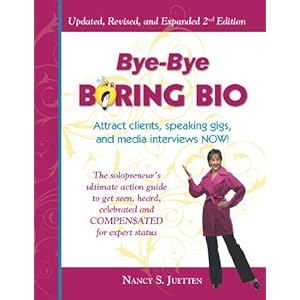
Dan: Nancy Juetten, author of Bye Bye Boring Bio, wrote a press release about her book. We got it printed on at least 40 media web sites.
Reporters called her and wanted to interview her and
review her book. I don’t know if that happens to everyone, but I’d consider that the icing on the cake.
She took the credibility of those media placements and pitched herself as a guest expert on Rain Today, which is a very big and popular site for professional services companies. She got on the teleseminar and was able to pitch her book there. All in all she said this was the best PR move she made this year and her book sales were strong.
Lisa: How do you write a good press release to show up high in the search engines?
Dan: I’ll share several tips during our teleseminar. Here’s one: Use the most popular keywords for your topic in the headline and first paragraph so the search engines know how to index your press release.
Lisa: Any other tips on Search Engine Optimization? [getting search engines to put your site up high in their search results]
Dan: Yes. Put links to your website in the press release. You can provide several links, so I’d suggest you do that. Put a link to your home page, your book sales page and your squeeze page [the page from which you’re selling something]. That formula should work for most people. If your book is already published, you can add a link to your Amazon sales page.
Lisa: I love how Nancy used her press release. Can you say a little more about how authors and entrepreneurs can use their press release once it’s posted?
Dan: Here are three ways:
1. Tweet a link to the article. I do this for my clients, when they tell me about publicity they get via PR LEADS. I use a provocative title to get attention. For example: Need writing tips for a job application? @prleads client Diane L Samuels gets publicity on Monster.com http://ow.ly/2tGcI
The keyword “publicity” makes sure that people searching for “publicity” on Twitter will see this. Use the hashtag function (#) with your particular keywords.
2. Post the link on your Linked In profile and relevant groups on Linked In: Don’t say “I’m quoted here. ” Tell people what they can learn by reading the article.
3. Send the link and article to your prospects, clients and followers via email.
Daniel Janal is an internationally-recognized speaker, Internet marketer and best-selling author. He has written six books for John Wiley and those books have been translated into six languages.
A former public relations executive, Dan Janal was on the PR team that launched America Online and personally directed the PR launch of Grolier’s Electronic Encyclopedia, the first consumer software program ever produced on a CD-ROM.
Join me on Dec. 9 at 1:00pm Eastern when I interview Dan about How to Get Publicity on Major Media Websites.

One of my Bring Your Book to Life students e-mailed me to say that she would be meeting a VIP in the medical world in a few short weeks at a networking luncheon through her husband’s business.
She asked how to best approach him. A foreword or even a blurb from him would be a real coup. And perhaps he might offer advice on the book publishing and promotion front.
In the old days, she’d probably have to wait until the event to introduce herself, but nowadays we can connect easily and become part of someone’s community at the click of a mouse through social media.
I suggested she read his books, then check out his blog and subscribe, asking relevant questions or making comments of substance on his posts that add value to the discussion. I also suggested she see if he has a facebook fan page, twitter id, etc. and connect in these social media arenas, as well. Here’s a place she can add value for him by retweeting his tweets or sharing his updates.

Whether he remembers her or not, she’ll now be part of his online community and can introduce herself accordingly. She’s no longer a random stranger, but part of his tribe.
And most bloggers are particularly grateful for those who add to the discourse on their blogs, so he’s likely to remember her unless his blog gets hundreds of comments. Authors appreciate their fans.
Is this disingenuous? I think not. It’s easier to meet people and become part of their circle through social media. To take advantages of the technology just makes sense–and it’s part of what successful authors do. If you can contribute to someone before you ever meet them, why wouldn’t you?
So, if you’re planning to attend an event or book signing with one of your “paper mentors” and you want to connect more deeply, become part of their online circle before you physically meet. And think about what you can do for them, too.

A good number of my clients come to me with amazing credentials and great ideas, but little platform–they often don’t have a huge mailing list. They don’t necessarily speak to thousands of people dozens of times a year. And they haven’t been on Oprah…yet (a few of my clients have been–but not the majority!).
If they’re looking for a traditional publisher, I often suggest they sign up for the reporter queries on PR Leads and helpareporter (also known as HARO). As more people find out about help a reporter, it’s gotten doggone competitive to be chosen as the expert the reporter quotes in their article.

My client, Dr. Craig Malkin has a 75% success rate with the responses he’s sent through queries from PR Leads and HARO. Before I suggested these do-it-yourself PR methods, he’d never had a stitch of publicity. On his first query, he ended up quoted in Match.com’s Happen Magazine online. Not bad for a rookie.
How does he do it? I interviewed Craig to find out his secrets.
Book writing coach (aka me): What do you do when you respond to a PR Leads or HARO query? What goes through your mind in terms of how to present your information?
Craig: I spend time with each query to make sure I’m absolutely clear about what the journalist is asking for. Then, I try to think like a reporter.
What quote would make the story stand out? Is there a new spin on old information that could make the idea more interesting? I try hard to come up with tips if I can, because journalists absolutely love them.
I make sure I’m packaging facts in a compelling way, and I always try to craft at least one catchy sound bite. Journalists have precious little time, so I know my best shot is to give them something that’s extremely easy to use.
When it comes to being quoted, less is always more (case in point). If I know, for example, that research proves we can be affected by our friends’ moods, I might say something like, “Depression is contagious.”
I’m not famous (yet), so I want to make it painful for reporters to delete my e-mail; I figure they’ll take a snappy quote from an unknown expert over a flat one from a celebrity any day, because they want their story to stand out.
It works most of the time.
Book Writing Coach: Do you start by saying who you are or by answering the question/query?

Craig: I always use the same formula, recommended by Dan Janal of PR Leads
1. Who I am (including media experience)
2. What I have to say (the quotes)
3. How to reach me
Book Writing Coach: How much info do you give? Do you often give more than one answer or tip?
Craig: I let inspiration dictate how much I write. If I’m being asked for tips, I always send a minimum of four. Don’t be afraid to send more (as long as they’re short), but bear in mind, if you send too much, reporters will probably get overwhelmed and skip even the best quotes.
Book Writing Coach: How do you make it visually easy to read?
Craig: I put my best quotes in italics and a different color. Often they have only a minute to look through hundreds of e-mails, so you want your best stuff to stand out. I also break the e-mail into three to four very short sections.
Book Writing Coach: Can you give an example of a query you responded to for a national website, magazine or newspaper and what you said that grabbed the journalist’s attention?
Craig: Here’s one that landed me an interview with Marie Claire. You’ll notice it’s extremely brief, with a few lines set off in blue italics.
___________________________________________________________________________________________________________________________________________________________
My name is Craig Malkin. I’m a clinical psychologist who taught and trained at Harvard Medical School. I’m currently writing a book about how we control attraction.
Despite the saying about absence making the heart grow fonder, distance rarely cranks up the heat. Don’t count on the strength of your love, alone, to keep you connected. If you can’t rely on seeing each other, you have to work to keep the connection alive in other ways.
When you’re away from one another, exciting, new people and experiences may be a dime a dozen. You’ll need to preserve some excitement with your partner if you want your relationship to compete with all that novelty.
Schedule regular phone calls, IM, or text check-ins that both of you can look forward to and expect. It doesn’t have to be daily, but it should be scheduled, to ensure that it happens—and more than once a week. If you enjoy spicing things up with sexy notes or creative video chat—even better. Exciting experiences strengthen attraction.
If either of you feels reluctant to schedule times to connect—with or without the spice—consider taking a break. You’re going to have hard time keeping up the connection without these moments together—and that leaves a lot of room for destructive insecurity and jealousy.
_________________________________________________________________________
Book Writing Coach: Wow, that’s a superb query. Catchy soundbites, but it’s substance, not fluff. What’s some of the biggest publicity you’ve gotten through HARO or PR Leads?
Craig: I’ve been quoted and interviewed twice for Match.com’s, Happen. I’ve also been interviewed and quoted by Marie Claire, The Atlanta Journal Constitution and, in December, I’m slated to appear in Women’s World. I’ve also almost landed a quote in Woman’s World twice—as a result of which I made a connection with a reporter who liked me enough to agree to be mentioned in my book proposal as a media connection.
Book Writing Coach: Any words of caution….something to be aware of?
Craig: Do your research before you respond. I learned that lesson the hard way. In one case, a reporter copied every thing I wrote and passed it off as her own. In another, I was all set for a pod-cast interview, and first the guy forgot the time, then he kept interrupting me because he wanted to hear different answers. Try to get a sense of who you’re talking to if it’s not a big name media outlet. At least do a Google search.
Book Writing Coach: Thank you, Craig.
And, dear Reader, do you have any tips or secrets to share that helped you get quoted or featured in a magazine, newspaper or online article? Please comment and share your tips, as well as your questions. Craig and I are both happy to respond.

Someone recently asked me the best way to set up book signings–go in person, call, or write a letter or press release and follow up with a call?
Whoa. I told her I’d first step back and look at the big picture. Book signings have their place but they can also be the largest waste of time. I remember a great signing at Barnes and Noble in Warwick where the manager had end-capped our book (put it on a separate display table) and we sold 25 books before the signing ever took place–YAY.
And I’ve had signings where I sold four books, two of which were to my mom (It was Newport in the Fall and a perfect beach day). No one but my mom and a neighbor came into the store that day.

A few strategic in-person book signings can provide some word of mouth traction and good local publicity, if you do it right. One key would be to couple the signings with a great press release that offers tips for a media friendly topic related to your book (rather than making the press release about the book itself).
Consider also a virtual book tour or blog tour where you can reach many people, over a longer period of time, and never have to leave your home.
Now, a few well-chosen venues can work well. If it’s easy, go in person. You’ll make a personal connection and maybe even get ideas together how to make the event most successful. Go for quality over quantity–someone who will help get people to the event or a place with lots of foot traffic.
You may also want to do what Kathy LeMay has done for The Generosity Plan. She offers her services as a keynote speaker to companies who want to offer extra value to their clients and customers (such as financial services companies) and to large nonprofits like the “Y” and philanthropic foundations.
If you’re approaching organizations, like the YWCA or a corporation, a letter with phone call follow up can work well. The main thing is to be strategic about every event you choose. How many people can you reach in each event? Can you garner publicity from the event? Will it be well promoted? Does it have viral word-of-mouth potential?
You can find out more about Kathy’s complete book event strategy in my guest blog post at marketingtipsforauthors.

These past few weeks I’ve been preparing for my presentation for Harvard Medical School’s CME publishing course, which begins on Thursday. I’ll address 200 or so aspiring authors on the topic of blogging and social media in the ballroom of the Fairmont Copley Hotel.
The audience will probably include people who belong to twibes and those who will think I have a speech impediment if I mention them. I’ll have done my job if, by the end of my talk, they decide to put a stake in the social media universe.

There are over 400 million active users of Facebook. As a student in my book writing class, Leadership Coach Carrie Beers, pointed out, “Imagine reaching a quarter of a percent of them…that’s a million people!”
It’s almost guaranteed that a large subset of your audience are on social media–and they’re the ones who will organically spread the word and tell others about your book and your work.
But how do you harness this raw power of social media?


Social media coverage can lead to publicity in more traditional arenas. Take Switched at Birth. A YouTube video helped land coverage in the Patriot Ledger, a Massachusetts newspaper, which included a link to the YouTube video. When ABC-TV saw the article, they checked out the video and decided to cover the story and shoot their own footage.

Dr. Sara Stein uses her blog, Facebook, and Twitter to support her book, Obese from the Heart. She tends to use social media to share information, provide in depth responses to news topics and share her own ideas and experiences around obesity. Her social media presence has resulted in publicity via national radio, local PBS-TV and local newspapers. People who’ve found her through social media have invited her to give talks nationally. And, yes, she doesn’t have any exact numbers, but she hears from people who say they bought her book because of a tweet or blog post they read.
If you’re looking to hear more about how aspiring authors can use social media, or if you want a three day immersion into book writing/publishing, hear what agents and publishers are looking for right now, find out how to write a great book proposal and meet agents and publishers in person, join me and the other faculty of Publishing Books, Memoirs and other Creative Nonfiction offered through Harvard Medical School CME. I’d love to see you there.

People ask me about the process of getting a literary agent. You probably know you need to submit a query (or meet an agent who says, “Yes, I want to see your proposal”), then submit your book proposal (a significant document often 50-80 pages), then wait.

But what’s it like from the inside? I asked Dr. Randy Kamen-Gredinger to share her experience of finding an agent. And some of the things her agent asked for in the process before signing.
During a course at Harvard Medical School on Writing and Publishing Creative Non-Fiction Books, surrounded by colleagues interested in learning the ins and outs of writing books and getting them published, Randy says she, “felt confident I, too, had a book in me.” She decided her book would focus on relationships.
When Randy started in my book writing course, she “hardly knew how to use a computer” by her own admission. As a psychologist with a very busy private practice, she didn’t really need to use a computer much beyond checking e-mails and Internet searches.
Entering the world of the aspiring author meant learning many new skills–not just how to structure a book and write in a compelling way. Randy quickly became skilled on her Mac, began organizing material collected throughout her career as a therapist, and created keynote addresses on a variety of topics that related to her book.

After making headway on the book, Randy wrote her proposal. Literary agent Jeanne Fredericks liked the book and saw its potential. Still she wanted to see several revisions to the proposal and a more compelling title. At a gathering of twenty-five women friends in Randy’s living room, led be a trained branding expert and facilitator, they came up with the title What Women Need: The 12 Keys to Gaining Balance and Happiness.
Jeanne requested an edited video clip of one of Randy’s speaking engagements and four chapters of her book. Nine months from the time of the initial submission, Jeanne accepted the proposal and formally became her agent.
Was it time to submit the book to publishers? No. Her agent advised her to continue building her platform and become a “thought leader” in her field as she continued to write her book. She developed a presence on Facebook and Twitter, gave an occasional radio interview and returned to the lecture circuit after a many year hiatus. (At one point she had shared the lecture platform with greats like Dr. Herbert Benson, Jon Kabat-Zinn and Joan Borysenko).
With the help of a dear friend and savvy internet marketer, Alan Bergstein, Randy built a new website and blog.
Response to this site about a wide range of women’s issues far exceeded expectations. Jeanne thinks the site will be an important feature in the selling and success of What Women Need.
Randy admits, “The process of writing my book became a much bigger deal than I ever imagined. It’s been an amazing, and sometimes frustrating, journey. Building my platform with speaking engagements, writing for various publications, building my website and blog, creating videos for YouTube (and next webinars) continues to bring all kinds of wonderful and unexpected surprises. The deeper I go down this path the more compelling it becomes.
“Developing the website is especially fulfilling because it all of the other elements. Though still in its infancy DrRKG.com has become the umbrella of all the other activities going on in my professional world. It continues to evolve.
“As a psychologist I have been somewhat constrained by the confidential component of my work. Expanding my horizons as a speaker, writer and coach have given me a venue for reaching a much greater audience and making a difference on a larger scale.”
While it may seem a bit frustrating for aspiring authors to do so much up front work, the platform building and advance preparation means that, when your book comes out, you’ll have pent up demand for your book and you won’t be rushing to catch up and create an audience from nothing. Can’t you just see those books flying off bookshelves and virtual shelves?

I’ve been “talking” by e-mail to Dr. Ellen Weber Libby, whom I met a few years ago at the Harvard Medical School CME publishing course.
Elly and I immediately connected and I became first her book proposal coach and then her book writing coach for The Favorite Child, which was published last month by Prometheus Books and has been getting lots of buzz.

The Favorite Child, a ground-breaking book, is the first book written on favorite children and is the only relationship book that applies to everyone. Everyone grew up as the favorite, overlooked, or unfavorite child. The book answers many questions, such as:
– What happens when a parent has a favorite child?
– How does this favored relationship affect that child when they grow up and become and adult?
– How does it affect that person’s relationships?
– How does favoritism affect other siblings?
…and much more, of course.

I asked Elly what it’s like for her to be suddenly marketing her book compared to writing it.
Elly replied, “When writing a book, I have 300 pages to tell my story. I pace the unfolding of the story, wanting readers to be interested in the details and wanting them to read on.
“Each chapter is a distinct unit with a beginning, middle, and end, smoothly connected to what comes before and after. Upon completing the book, readers need to feel satisfied and know they are wiser for having read my book.
“Promoting a book requires a different mindset. In just a few minutes I need to convey a sharp and concise message, which will entice each person in the audience to buy my book.
“My goals is to NOT tell the reader too much but to stimulate them to go to the next step – to purchase The Favorite Child. This is accomplished by consolidating the 300 detailed and well thought out pages in to the two or three major points which will be most engaging to the audience.
“What is common to both the writing and promoting of a book is the writer’s struggle of knowing how much or how little to say. When writing, the writer does not want to drown the reader in irrelevant details; when promoting the book, there isn’t the time to encounter this risk.
“Conversely, when promoting the book, the writer does not want to engage with interviewers in free-flowing discussion as one would with a friend over coffee: the writer wants to use the time wisely to make succinct points that will help sell the book. But, when I wrote The Favorite Child, it was the free-flowing discussions I had with friends and colleagues that added richness and texture to the book and helped me clarify and develop my opinions and prose.”
I asked Elly how she likes all the interviews and book promotion activity.

“I enjoy promoting the book. Everything about the experience intrigues me. I’ve been interviewed on shows with dramatically different audiences, and it is amazing how each interviewer gets to similar information from such divergent approaches, some with humor, others provocatively, and some directly.
“And, I still can’t get over the fact that while in Paris a friend listened to an interview I did on NPR in NYC on her computer.”
You can purchase The Favorite Child at Amazon.com. Read Dr. Libby’s blog on Psychology Today.
It’s always a thrill when my clients’ books come out and I get that brown cardboard package from Amazon. When Deb Scott finally announced that her book was here, though, I found it especially fulfilling.
Deb had some huge setbacks in her process…making her a great example for the role or perseverance in the life of an author.
Both her parents passed away within a year. Deb took care of them until their deaths, as sole caregiver. After that, she set her sight on writing and publishing her self-help book, The Sky is Green and the Grass is Blue: Turning Your Upside Down World Right Side Up.
Her inheritance was supposed to provide the security for her to pursue her new dream and career as an author, speaker and trainer–and to provide the funds to launch her book. But in the middle of preparing the book for publication, she lost all her inheritance and savings to the $200 Millennium Bank Ponzi scheme.
Deb saw it as an opportunity to dig deeper into her own message of finding the good in all crazy situations and facing it all with a sense of humor. I’m sure it wasn’t easy! But she did it.
While you probably (I hope) won’t lose your life savings to a ponzi scheme, I can guarantee you that you will meet challenges when you decide to write and publish your book.

With my first book (which I co-authored), it took seven years from my initial idea to a published book in my hands. Challenges included many rejections from literary agents (and those were in the days where you contacted one agent at a time) and, later, bookstores refusing to “replenish” the book because of its dimensions (i.e. they would respond to a special order of 1 but would not carry it).
At times I felt tempted to concede defeat. But I snapped out of it and always asked, “What information does this setback carry? What do I need to do to turn this around?” In each instance, perseverance paid off.

In fact, the problems with the cover and dimensions of our book led our publisher (with some encouragement from my co-author) to re-publish the book with a new cover, new title and new dimensions.
We were able to use the great press we’d gotten on the new book and ended up with even more powerful national publicity–from USA Weekend to Glamour Magazine to CNN Headline News and much more.
If you want to write a book and get published, the one thing I can guarantee you is that challenges will come up. Here are the three things you need to meet them:
1. Give yourself time to feel disappointed. But don’t wallow there.
2. Ask what you need to do differently and take the first step as soon as you can.
3. See if you can turn the disadvantage into an advantage. For Deb, that meant going back to the message of her book and living it more deeply. That resulted in an authenticity and a powerful story (that makes an impact in her press releases and consequent radio interviews.
Deb advises, “When you get discouraged, want to give up, or find those negative people creeping in to saying, ‘quit’ – visualize yourself holding your book in your hand, meeting someone who says, ‘Thank you for writing this book – it was fantastic and I loved it!'”
I agree. When students in my book writing classes get stuck and stop writing, I remind them to connect with why they’re writing the book and the impact they want to make on their readers and their world. Often it helps to have a vision statement you can read aloud to yourself whenever you work on the book.

One of my private coaching clients called today as we’re wrapping up her book proposal and making our short list of agents. She had a number of next step questions on her list, but one stuck out for me.
A colleague had asked to interview her for a chapter in the colleague’s book. The colleague had written a successful first book and things looked good for book two. Seemed like an opportunity.
But something just didn’t feel right to her.
Fortunately, she listened to her intuition. I took her through an exercise to meet and communicate with her muse. We asked her muse what she wanted her to know in this situation.

Her muse was clear:
Sometimes it feels uncomfortable to withhold information, but books are about timing and freshness–so, please don’t give it all away.
Another client is working on a groundbreaking book on relationships. We knew that once he put his ideas out there, it will be easy for others to apply his perspective, techniques and tools–a good thing. But this made it very important to wait until the book is published before sharing the gems.
He’s done radio interviews and several interviews for articles on top dating websites and magazines. Early on we brainstormed about what information was tangential to the book and okay to share with the media and what information he needed to keep under wraps until his book comes out.
Another reason to keep information about your book to yourself is to protect yourself emotionally. Only share with people you know will be supportive.
And a third reason for reticence is that you can dissipate your creative energy if you talk about it instead of writing it.

Are there times to be more open? Absolutely. You may be teaching workshops on the material and need to use the juiciest bits for your teaching. Do put a copyright sign on your training materials for one level of protection.
I don’t mean to make you paranoid. Most people will not steal your ideas, but once the ideas are out there, it’s just harder to have your stuff be seen as fresh. To paraphrase Ben Franklin, an ounce of protection keeps your writing pure!

I was the first one up in my house this morning. That’s unusual. I bounded out of bed and ran to the computer before anyone could wake up, reflecting on last night’s teleseminar, which I hope you had a chance to hear.
Morgana Rae interviewed me about writing and publishing a book right now in this market: how do you get started? Is anyone getting publishing contracts nowadays, or should you just self-publish? When is it better to self-publish anyway? People asked lots of great questions. The call reminded me how important it is for us authors to be out there in the world.
It isn’t necessarily comfortable. It’s much easier to sit here and blog at my desk than try to learn a new conferencing technology, put myself on the line, answer questions, risk looking silly (which I’m sure I did when I tried to figure out whose mikes were on and when I got so focused on figuring out whose hands were up that I missed a question).
It ain’t always pretty being out there. But writing a book is about being out there in the world, playing big, making an impact, reaching more people. And often you’ll look polished, but you’ll still make mistakes here and there. And that has to be okay, too. If you want to be a successful author, you need to give yourself permission for those mistakes, those silly moments, and say, “That’s okay. I’m playing big now and it comes with the territory.”

One way I talk myself out of the discomfort and into inspiration is by reminding myself of my vision and goals–why is it so important to get my message out there? What’s it going to do for my audience? What will it do for me? For my community and the world? Those questions get me back in the game and connecting with the radiance within me, within all of us.
Here’s some more radiance in case you missed yesterday’s call:
1. Join me and Lisa Almeida for an information-packed interview on How to Write Your Book and Grow Your Business at 2pm eastern today.
2. Find out about–and register for–Bring Your Book to Life. This program will take you through the entire process to write a book successfully in record time and with a certain ease. We’ll be making a special offer on my call with Lisa, so listen for the discount code & sign up by midnight tonight!
3. Listen to my interview with Danielle Hampson on Mind Your Business radio, where I share how other authors are using their books to grow their businesses, some of the decisions you need to make, and how the current market affects those decisions. I think the interview will be archived at the end of the week so listen today!

I recently spoke with a client who is working hard on growing her following so that she can increase the chances of selling her memoir to a publishing house. I had suggested she contact another client of mine for ideas in her field–the person who had initially put her in touch with me.
This mutual friend offered a suggestion for radio publicity, but it meant my client needed to present herself as a psychic, not exactly the way she presented herself to the world–and not how she wanted people to see her. In fact, she’d pledged never to present herself this way, despite her “psychic” gifts.
Her husband urged her to reconsider and she e-mailed me for my opinion.

First, I congratulated her for thoughtfully considering the opportunity. On the one hand, any opportunity to get known is a good thing. On the other hand, if she’s branding herself, or as Christina Katz puts it, creating her public identity, she needs to think about how she wants people to view her. Does the label of psychic take away from her vision of her image or can it add to it? How will this label affect how her audience views her and who her audience is?
It’s not a test with a right and wrong answer. She needed to look within.
I came up with a list of questions for her to journal about.
As she answered the questions, it became clear to her that this wasn’t the right opportunity for her. Perhaps, though, taking the time to consider it helped her be open to a more fitting option. Within a day, a new opportunity emerged that fit her identity and vision spot on.

As an author or aspiring author, you need to use social networks to help create your platform and, eventually, promote and sell your books.
Yet, social networks can eat hours or days of your time with little impact. This is because social networks aren’t generally built in a day. If your social network is going to work for you, you want it to be filled with people who know and love you.
Should you friend or follow just anyone who asks? I say no. Be picky. That way, when you send messages or invitations to people on your list, you know they actually care and that they won’t report your communications as spam, for one thing.

If you’re a busy and successful professional, I suggest just taking a couple of hours a week to build your networks and friend/follow people on Facebook, Linked in, twitter, etc. whom you know well from different walks of life.
If you are just joining these networks, create a profile. Ask colleagues for recommendations on Linked In.
Then try a few apps (applications). Here’s the latest application I tried on linked in. It’s a one question poll on whether you want to write a book in the near future. I’m wondering how it’ll work. Here, you can take the poll right here.
I’d love to hear from you. What social networks do you belong to? What strategies do you use? What are your favorite apps?

I’m going to out and out brag here. July is shaping up to be an exciting month for my clients and we’re celebrating. Want to hear their secrets of success?
First, here’s the good news. In July alone:
– Three of my clients signed contracts and/or received offers from publishers for their books.
– Two other clients are in discussions with three major publishers each, including several in person meetings.
– Two others signed contracts with top agents.
So, what can we learn from these successful authors? What are they doing right in this market where people are saying it’s harder than ever to publish a book? Here’s what these seven authors have in common:
1. They’ve worked on their platforms. Some of them had powerful platforms to begin with, but many did not. They grew their platforms while writing their book proposals. They’ve done everything from subscribing to Help a Reporter Out (which is free) to PR Leads to starting a wordpress blog to tweeting.
Note that not all of them have huge mailing lists–some have gotten great pr (TV, radio, print, internet), some do a great deal of public speaking and some demonstrated the potential to take their public speaking to the next level–and that was enough because of the strength of other aspects of their proposal.

2. They clearly thought about their market. Several, including Dr. Terri Major Kincade, went to their potential audience directly and asked for feedback–what were readers looking for to solve their problem? What were the biggest challenges they faced? Which chapter titles worked for them? Which did not?
3. They performed a thorough comparison with other successful books on their subject. They focused on both what was similar to these bestsellers and what was different. They clearly demonstrated that their books had something unique to offer, something timely, catchy and compelling, and that their books also had much in common with bestsellers and very successful books.

4. They demonstrated why they are the ones to write their books, because of their expertise, their interesting stories and the unique gifts they alone have to offer…and, yes, back to platform–many of them have a following.
5. They opened their proposal in a compelling way. You have to grab agents’ and publishers’ attention in your first paragraph or they probably won’t even read further. Ideally, in the first paragraph, the reader gets the sense that you have a highly marketable book concept, a good size market, a significant platform. Sometimes, it also works to start with a compelling story that draws the reader in.
Of course, this is just a starting point. To write a truly solid book proposal, you need a proper road map. I recommend Michael Larsen’s How to Write a Book Proposal for its winning format and specific details, as well as sample proposals, and Terry Whalin’s Book Proposals That Sell, for helping you get into an editor’s (publisher’s) mind.
What are your concerns about your book proposal? Ask your questions here. Or share why your book proposal got you a publishing contract or agent. And good luck with publishing your book.
In this interconnected world, we’re seeing that authors who engage their readers and create a sense of community can achieve great success, like the phenomenal success of Twilight, due partly to a huge Facebook and social networking fan base.
As you know, my focus as a writing coach is on adult nonfiction. While the ideas I’m about to share are being implemented for a novel, you can also be creative in applying them to nonfiction, even a how-to book.

My good friend, Donna Montalbano, author of The House on Benefit Street, has been serializing her second novel, The Shop on Wickendon Street.

I asked Donna how she came up with the idea of the contest.
“Crazy as it sounds, I stumbled on the idea while working with a travel agent on a trip to Italy. At the bottom of her emails, it said: How am I doing? Let me know if I can serve you better.…
I began thinking, “How am I doing as the author of The Shop on Wickenden Street?” Serializing the book on my website provided a rare opportunity to find out.
Before I post the next couple of chapters, which will essentially solve the mystery, I want to know if I am holding up my end of the unique bargain that exists between the mystery writer and the mystery reader.”
What bargain? you might ask.
Donna says, “I, the writer, promise to give you, the reader, a sporting chance to solve this mystery, but I am going to do my best to keep you from doing it, by hook or by crook! Unlike real life, in the mystery novel all the clues must be hidden in plain sight. The writer’s job is to make the reader miss, misinterpret or ignore those clues. The highest compliment a mystery writer can receive from a reader is: Wow, I did not see that coming!”
How is Donna doing, by her own standards of success?

“I received a few dozen emails, and some readers have come close, but no cigar. I intend to run the Whodunit contest for a couple more weeks, then post the remaining chapters and announce the winner or winners”
The prize is an autographed copy of Donna’s first book, The House on Benefit Street. The Shop on Wickenden Street is the second in the series set in historic Providence, Rhode Island, featuring that spunky fiftyish widow, Angie Russo.
How can we nonfiction authors engage our readers similarly?
Comment here with your ideas, whether you’ve already implemented them or just got inspired!

My first time on TV, no one told me not to wear busy designs with lots of color. I wore my most stunning spring suit and it danced around the screen hypnotically (and distractingly) when I appeared on ABC World News with Peter Jennings. Of course, I should have asked…or researched. Sigh.
I was never able to use that footage as a sample interview, not because I spoke poorly, but because I looked like a complete amateur by the way I dressed.
Those were the days before the internet, when you actually had to call people to find out such information. But just in case, like me, you haven’t thought to ask the question, I’m bringing it up for discussion.
Maybe you’ve already appeared on TV, maybe your book is coming out and you’re preparing for the big day, or maybe you’re working on building your platform and you realize it’s best to start right away–maybe even by appearing on some local cable stations to get your feet wet.
Whatever stage you’re in, it’s time to do your research and learn how to dress for TV. There are more caveats to be aware of than just dizzying fabric design.
I asked my friend and writing coaching client, Chris Fulkerson, a professional image consultant extraordinaire, to provide her top tips for dressing for TV.
Says Chris, “Once you’ve defined your key message and practiced answering possible interview questions, you need to answer the most important question of all – what will you wear?”
As a professional image consultant, Chris has seen many people improve their credibility and image by selecting clothing that properly fits, is in their best colors, expresses their personality, and enhances their figure. A television appearance is no different.
Chris points out that, “When we look at someone for the first time we look at clothing first and face second. Studies have shown that we evaluate each other in two seconds and less. Keep that in mind and follow these tips when getting dressed for your television interview:

1. If you are not familiar with the television station, phone them and ask what color background is used in the studio. You wouldn’t want to show up wearing blue if they have a blue background, you’ll blend in and not stand out.
2. Your makeup, wardrobe, and hair should be consistent with your message. If your message is conservative, a suit would be best. If your message is fun and informal, wear a sweater.
3. Because of the studio lighting, studios are kept cool. When the lights hit you, you could warm up quickly. If you perspire easily, consider wearing dress shields.
4. Solid colors are best. Avoid black, white or red and avoid print, plaid or checked clothing. They can affect video quality.
5. Select matte fabrics. Men should avoid shiny print ties.
6. If wearing a suit, carry your jacket into the interview so it is not wrinkled. Shorter jackets for women work best since the fabric doesn’t fold at the hips.
7. A lapel microphone and transmitter (the size of a pack of cigarettes) should easily attach to the outfit you selected.
8. Avoid ruffles, slit skirts that need to be held closed when seated, jeweled tie tacks, and any flashy jewelry that reflects light.
9. Avoid anything that could jingle such as jewelry or buttons. The noise will be picked up by your microphone.
10. Men should wear matching knee-length socks and shoes that complement the suit color.
11. The television cameras can make you look weightier than you really are. If you want to

12. Remove coins from your pockets, leave your cell phone in the car, swallow your gum, stay hydrated, and don’t walk on the set with a pen in your hand.
Chris’s final advice? “Before leaving the house, sit in your outfit in front of a full length mirror. Do you feel comfortable, confident, and happy with what you see? Do you have good posture? Double check your hair and makeup then don’t forget your best accessory – your smile! I’ll be watching you.”
Thanks, Chris!

My Publisher Tamara Monosoff: From the gorgeous cover to inner design, to the original inspiration for QR codes and putting every single one of those crazy videos on my website, and guiding me patiently throughout the process, Tamara is my dream publisher. Thank you!
I could probably go on thanking deserving people for another twenty pages, so for those not listed, please know you have my gratitude.