Updated 8/11/24
This is an updated version of my earlier post on how to choose your book proposal sample chapters. I’ve updated it to share some excellent new questions that came in from a book proposal client.
How Many Sample Chapters?
If you’re interested in being published by a traditional publisher, you probably know you need a book proposal to interest literary agents and publishers in your book. That includes enclosing 1-3 or even more sample chapters. How do you choose and how many?
Many agents are happy with one or two chapters to start but they often request more before you actually sign the deal. You may want to give them two to start with. On the other hand, if you’re in a hurry, one will usually suffice—you can always e-mail the agent and ask their preference.
[bctt tweet=”But how to choose which chapter or chapters to include in your book proposal?” username=”LisaTener”]
One common strategy is to include your Introduction and a representative chapter, particularly if you are writing a prescriptive book such as how-to, self-help or business. For such books, chapters will likely be similar in structure and features and any representative chapter can work, as long as the material does not depend on understanding material in previous chapters that you are not submitting.
A case can be made for sending your Introduction and/or first chapter–after all, the Introduction should make the case for your book and should entice readers to buy it, devour it in one sitting and put your wisdom and tips into action in their lives. At the same time, if your Introduction and/or first chapter sounds too similar to your book proposal, pass on it and go with a later chapter that provides more depth.
You want everything agents and publishers read in your proposal to sound fresh (a good reason to ensure differences in your query letter and the opening of your proposal as well). You also want to be sure that if you submit a chapter than can stand on its own. If your chapter includes medical jargon that is addressed in an earlier chapter, you’ll—at the very least—need to include a note that tells us what information readers will already have.
[bctt tweet=”Questions to Ask Yourself in Choosing Sample Chapter(s) for Your Book Proposal ” username=”LisaTener”]
Given the above caveats, I’d use these questions for deciding on your book proposal sample chapters for a how-to or self-help book:
- Which chapters offer the most ground-breaking information?
- Which chapters have particularly compelling anecdotes, examples, statistics or stories?
- How about the best written chapter(s)? (if you’ve already written the book)
- What chapter(s) will be easiest to write? (if you haven’t written any yet)
- Which chapters answer my audience’s most pressing and common questions and help them the most?
Choosing Sample Chapters for a Memoir
If you’re writing a memoir, find the chapters that are most compelling, dramatic or suspenseful. What makes your memoir different? Any quirkiness or unique hooks? Definitely include chapters that capitalize on this. Note: with a memoir, you’ll need 50 pages as a sample and many agents/editors will want to see the whole book after that–so make sure you are ready.
 The 5th edition of How to Write a Book Proposal by Jody Rein and Michael Larsen
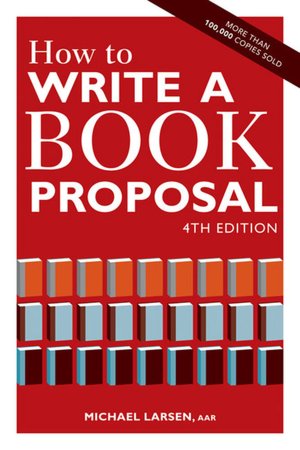
In How to Write a Book Proposal (4th edition), Michael Larsen answers the question of which chapter(s) with “send one that best blends freshness and excitement.” He also suggests asking yourself, “how you want editors to feel about your writing and your book when they finish reading your chapter: Use the chapter that will most effectively make them feel that way.” Note: There is now a 5th edition, which I recommend. I encourage you to turn to the sample proposals at the back of the book as you write each section as well, to find excellent examples of each section. You will find that there are variations in how authors present the material and you may well find a format that works particularly well for your book.
I also advise authors to use sample chapters that explore the range of the book. If there’s a section of the book with multiple chapters that focus on the scope of the problem the book will solve, followed by a how-to portion of the book that follows a specific structure, you may want to showcase both aspects.
[bctt tweet=”Does the Book Proposal Sample Chapter Need to be Completely Polished?” username=”LisaTener”]
Today, a client asked:
“Are they called sample chapters because they are not necessarily perfect at this stage but well beyond the draft stage?
I’m not talking about typos of misspelled words; of course that would not be in a sample chapter.
But are they called sample chapters because the agent might want to make changes before going forward to a publisher?
Or are they to be perfectly written, organized, and compete?
The reason I’m asking is I have been aiming for perfection which is why it’s taking so long.
But now I’m wondering if I’m making this a grand piano and maybe it doesn’t need to be, at least not right now.”
I’m so glad he asked. Now, this author is an excellent writer and a perfectionist. However, here’s a case where perfectionism is a good thing!
Here’s what I told him:
“The book proposal sample chapters should be super polished—your best writing. They are called “sample chapters” because they are representative of the book. Strive for perfectly written, organized, and complete, but yes, your agent or acquisitions editor (publisher) may want to change some things. Everyone likes to have input and they may have some good ideas we didn’t think of.”
Of course, one can overdo perfectionism. Send your sample chapter to an editor, get feedback, incorporate it, and when your editor says it’s ready, go for it!
Looking for more tips for writing a successful book proposal? This article details step-by-step how to write a book proposal as well as links to articles on writing various book proposal sections.
 Do you have questions about your book title, the audience for your book, and how niche or broad to go?
 San Francisco Writers Conference 2018 Guest Post by Cathy Turney


 I looked up their guest blogging guidelines. Uh oh. They didn’t seem to have any.

 So, here are my takeaways from the experience, as well as earlier experiences writing guest posts for
 As we look back on 2014 with gratitude, I thought I’d share some of my own top posts of 2014 along with some of the most helpful book writing and publishing posts from other experts in the field that will help you with many aspects of writing and publishing a book. Thanks to Mike Larsen, Jane Friedman, Michael Hyatt, Shelton Interactive, Nancy Tierney, Rachel Vane and Chris Freese for the informative posts I refer to here.
 I loved this post from my copywriter Nancy Tierney at Firecracker Communications. This tip for “Wild Horse Writing”–
 I’m not always the best at choosing images for my blog posts. In fact, I often default to my over-used head shot. So, I loved Rachel Vane’s post on
 Lisa: What’s the purpose of the
 Mike: The Conference is in its sixth year because feedback from attendees assures us that it’s very helpful in:


 Julia Griffin
 Jeanna Gabellini